Curatorial note. This essay accompanies a permanent installation at PacificaRomania, pairing the Mah Meri Moyang Harimau Berantai (Spirit of the Tiger in Chains) with archival materials from the Carpathian region and the Kedah Sultanate. It explores how cinema domesticated two monstrous sovereigns — and why indigenous art refuses that domestication. The essay is presented bilingually; use the language selector above to read the Romanian edition.Notă curatorială. Acest eseu însoțește o instalație permanentă la PacificaRomania, care alătură piesa Mah Meri Moyang Harimau Berantai (Spiritul Tigrului în lanțuri) unor materiale de arhivă din regiunea carpatică și din Sultanatul Kedah. El explorează cum a domesticit cinematograful doi suverani monstruoși — și de ce arta indigenă refuză această domesticire. Eseul este prezentat bilingv; folosiți selectorul de limbă de mai sus pentru ediția în engleză.
The PacificaRomania archive holds two sovereigns side by side: Vlad the Impaler, whose distant bloodline reaches the British throne, and Raja Bersiong, the Fanged King of Kedah, who became a tiger. Both were tamed by cinema. Both were, in truth, far more terrifying.
The globalised tourist icon — whether the Gothic castle of Transylvania or the exoticised jungles of the Malay Archipelago — is often a sanitised refraction of a much darker indigenous eschatology. Here we juxtapose the European cinematic vampire with the Southeast Asian were-tiger, anchored by the Mah Meri sculpture of the Tiger in Chains, carved on Carey Island, Selangor.
I. Blood-soaked genealogies
Let us first unspool the Carpathian thread. To grasp the metaphysical linkage between these two sovereigns we must deconstruct the blood-soaked genealogies of royalty that underpin their narratives. It is a heavily documented, if little-known, fact that the British Crown shares a distant bloodline kinship with the historical tyrant Vlad Țepeș — Vlad the Impaler. Genealogical researchers have traced a descent spanning some sixteen generations from Vlad III to King Charles III, through Queen Mary of Teck, consort of George V. Charles himself acknowledged the connection, remarking in a 2011 television programme that the genealogy shows him descended from Vlad the Impaler — a distant cousin across the tangled webs of Eastern European and German nobility. In 2017 he was formally invited by the mayor of Alba Iulia to accept the honorary title of Prince of Transylvania.
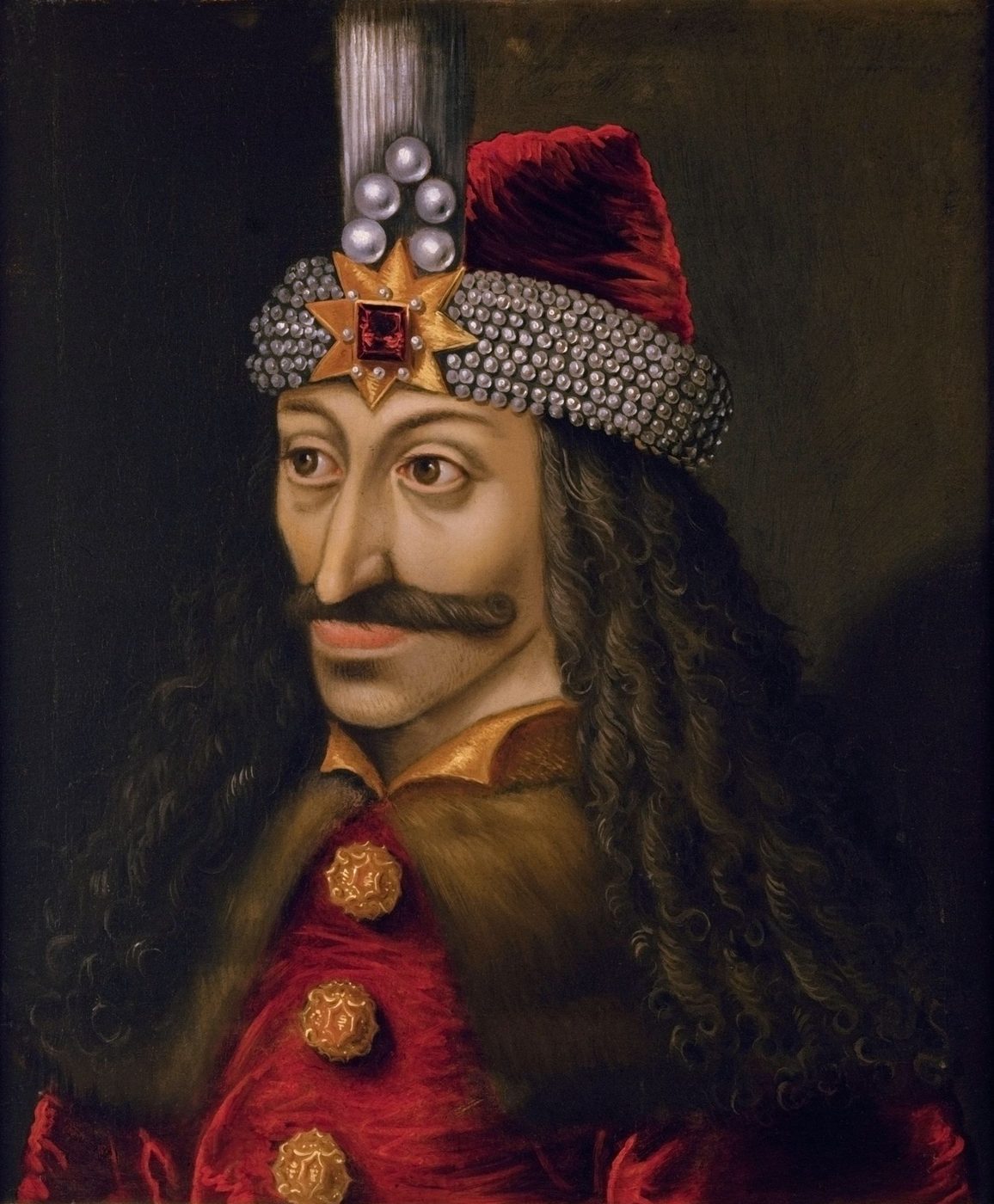
The irony is formidable. The Empire that sanitised its own imperial brutality abroad consumed, at home, the exploits of a distant relative through the lens of Bram Stoker’s 1897 novel. Stoker’s Dracula passed the censors of Victorian Britain by projecting the anxieties of parasitic imperialism onto a Gothic Eastern European prince. It transformed the flesh-impaling, nationalist voivode into a universal, vampiric archetype — a branding that has since turned the Romanian Carpathians into a global “Dracula trail,” effectively erasing the historical Wallachian ruler to make room for the celluloid count.
II. The Fanged King and the First Minister
A parallel act of cinematic rescue — and erasure — was unfolding eleven thousand kilometres east, in the royal house of Kedah. Tunku Abdul Rahman Putra Al-Haj, the first Prime Minister of the Federation of Malaya, was no mere political figure: he was a direct descendant of a dynasty that traces its mythical origins to the kings of the Hikayat Merong Mahawangsa. One of them was Raja Bersiong, the Fanged King.
In 1968 the Tunku took command of the story himself, writing the screenplay for the film Raja Bersiong. Produced at a reported cost of RM 750,000 — some ten times the average Malaysian film — it was the first Malay picture shot in colour CinemaScope. In his telling the king is innocent, the victim of a slanderous palace coup: the blood on his lips is only the juice of dragon fruit and pomegranate, the fangs mere propaganda. The message to a nascent post-colonial nation was plain — do not believe the whispers of traitors against a benevolent monarchy.
Yet the Tunku’s reimagining must be read against the pressures of its moment. Written in the shadow of Konfrontasi (the Indonesia–Malaysia confrontation, 1963–1966) and on the eve of the 1969 ethnic riots that would fracture the nation’s social compact, the film was as much a political intervention as a cinematic one — a calculated effort to project national unity and royal legitimacy onto a restless populace.
III. The original transmutation
The Tunku’s version is a deliberate departure from the folklore. In the pre-colonial Hikayat the tale ends not in exoneration but in apotheosis and transmutation. The king’s appetite for human blood grows until he sprouts fangs and preys upon his own people; horrified by his cannibal hunger, they rise and drive him into the deep jungle, where, cursed for his transgression against the natural and social order, Raja Bersiong is changed permanently into a Harimau Bersiong, a Fanged Tiger. He is no longer a monarch but a creature of the wild, haunting forever the rainforest boundary he once ruled.
This violent ending aligns with the animist cosmology of the Orang Asli, the First Peoples of the Malay Peninsula. In Mah Meri and wider belief the transformation of a human into a tiger — the Harimau Jadi — is not an escape from justice but its embodiment. When a person commits an egregious violation, above all murder or cannibalism, the forest spirits strip away the social soul and imprison the offender in a tiger’s body. There they become the eternal guardians of the jungle, the fanged boundary-keepers who defend the wilderness against human encroachment.
IV. The third erasure: Sandokan, the exoticist tiger
If Stoker turned a Wallachian voivode into a vampire, and the Tunku turned a Kedahan cannibal into a political martyr, then Emilio Salgari’s Sandokan is a third, distinct layer of distortion — born not of imperial anxiety or post-colonial nation-building, but of pure European exoticism. The Italian author, who never once set foot in Southeast Asia, wrote a cycle of swashbuckling serials whose protagonist is branded “the Tiger of Malaysia.” In Salgari’s feverish imagination this pirate-saviour roams an invented archipelago of noble savagery, a romanticised rebel fighting colonial powers with a tiger’s ferocity. Salgari seems to have drawn the figure from the Bornean rebel-prince Syarif Osman, and the name is popularly tied to Sandakan Bay in Sabah.
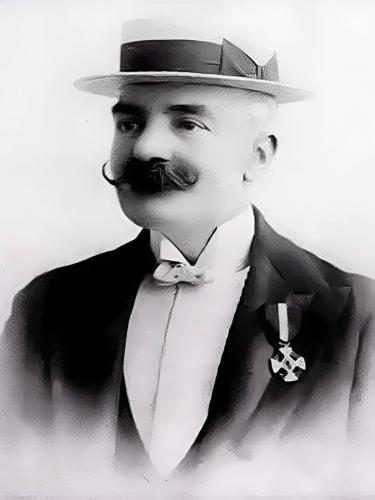
But where is the Harimau Jadi in Salgari’s tale? Nowhere. The indigenous cosmology of the were-tiger — the spiritual guardian born of blood-transgression — is replaced by a cartoonish Orientalist archetype. Salgari’s tiger is a metaphor for bravery and rebellion; it carries no ancestral memory, no curse, no ecological guardianship. It is the tiger as tourist attraction, a branding exercise that has since dominated global perceptions of the Malay archipelago, neatly erasing the Mah Meri’s chained, suffering spirit in favour of a dashing fictional prince. Contemporary cinema, through Salgari’s serials and their adaptations, has thus overwritten the indigenous guardian with a pirate fantasy — a final act of literary colonisation that the Tiger in Chains silently, woodenly, refutes.
V. The Tiger in Chains — materiality and symbolism
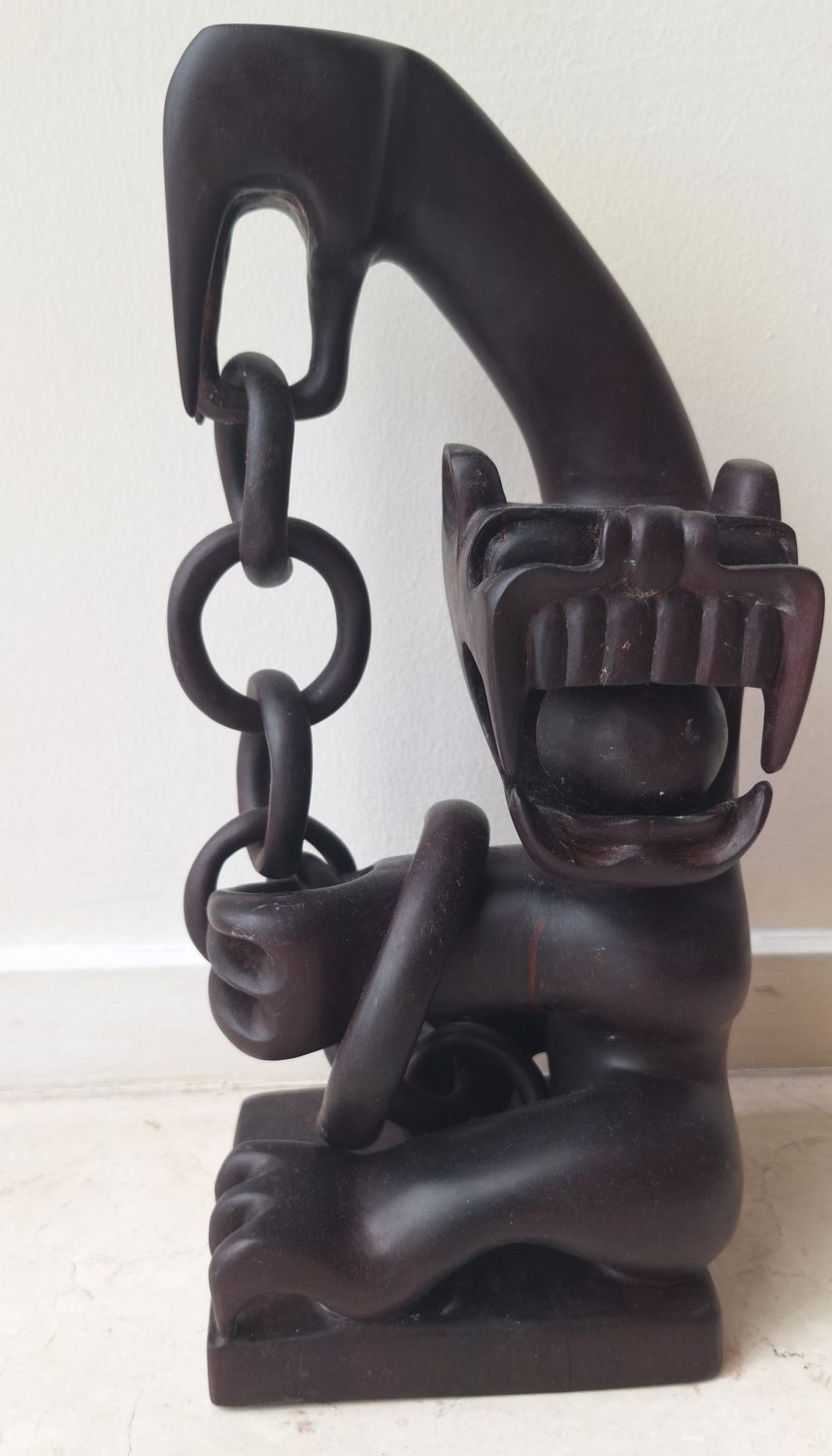
It is against this palimpsest of commercial branding, royal cinema and indigenous reality that we present a cornerstone of the collection: the AHPADA–UNESCO Seal of Excellence-winning woodcarving Moyang Harimau Berantai (Spirit of the Tiger in Chains), sculpted by the Mah Meri of Pulau Carey.
Standing just over two metres tall, carved from a single block of dense cengal hardwood, the figure’s humanoid posture is unmistakable. Its torso rises upright, arms braced at its sides, the musculature of a predator frozen mid-pounce — yet the stance is that of a prisoner awaiting judgment. The head retains the broad skull and alert ears of the Malayan tiger, but the deeply recessed eyes hold an unsettling human intelligence. This is not a decorative beast; it is an ancestor, trapped.
The archetypal tiger is bound in heavy shackles. Crucially, these are not carved wood but actual metal — forged iron links added by the sculptor to emphasise the physical weight of captivity. The surface of the wood is darkened not by paint but by decades of ritual handling and ceremonial smoke, a patina that testifies to its life as a living spiritual object rather than a mere ornament. The grain follows the arc of the tiger’s haunches, the natural lines of the timber converging at the shackles as if the wood itself strains against its binding.
The chained tiger is an audacious reversal of the Bersiong myth. Where the king was freed by his transformation to prowl the jungle as a supreme predator, the Mah Meri’s tiger is immobilised. The chains are not allegory for royal slander; they are stark markers of the devastation wrought by oil-palm monocropping and forced displacement — the silencing of the Orang Asli’s ancestral voice and the felling of the very forests the Harimau Jadi exists to protect. By receiving the AHPADA–UNESCO Seal of Excellence for Handicraft Products in South-East Asia in 2004 — awarded for its “excellence and standard-setting quality in craftsmanship… expression of cultural identity and traditional aesthetic value, and respect of the environment” — the sculpture transcends indigenous craft to become a diplomatic barometer of the global struggle to preserve intangible heritage and ecological biodiversity.
Conclusion: sovereign mirrors
The Wallachian Vlad and the Kedahan Bersiong are sovereign mirrors of political expediency. The cinematic vampire kept Romania’s historical brutality safely exoticised for a Victorian audience while cementing a twentieth-century tourist identity; the cinematic Malay king, exonerated by his own descendant, was engineered to shield a fragile federation from sedition; and Salgari’s literary pirate-saviour, invented by a man who never saw the archipelago, completed the trinity of erasure, stripping the tiger of its indigenous soul and replacing it with a swashbuckling fantasy.
Yet beneath the projectors and the pulp novels the Mah Meri carve the truest myth. Moyang Harimau Berantai does not roar; it strains in silence against its metal bonds. The chains that bind the tiger are not legends of slander but the real chains of deforestation and cultural erasure. The beast that once transformed to protect the jungle now needs us to unchain the jungle to protect the beast.
A complete Romanian edition of this essay is available within the PacificaRomania archive; use the language selector at the top of the page to read it.
Arhiva PacificaRomania așază doi suverani alături: Vlad Țepeș, a cărui descendență îndepărtată atinge tronul britanic, și Raja Bersiong, Regele Colțat al Kedahului, care a devenit tigru. Amândoi au fost îmblânziți de cinematograf. Amândoi erau, în adevăr, cu mult mai înfricoșători.
Icoana turistică globalizată — fie castelul gotic al Transilvaniei, fie junglele exotizate ale Arhipelagului Malaez — este adesea o refracție igienizată a unei eshatologii indigene mult mai întunecate. Aici juxtapunem vampirul cinematografic european cu tigrul-om din Asia de Sud-Est, ancorați de sculptura Mah Meri a Tigrului în lanțuri, cioplită pe Insula Carey, Selangor.
I. Genealogii însângerate
Să depănăm mai întâi firul carpatic. Pentru a înțelege legătura metafizică dintre acești doi suverani trebuie să deconstruim genealogiile însângerate ale regalității care stau la baza narațiunilor lor. Este un fapt bine documentat, deși puțin cunoscut, că Coroana britanică împărtășește o înrudire de sânge, îndepărtată, cu tiranul istoric Vlad Țepeș. Cercetătorii genealogiei au urmărit o descendență ce se întinde pe vreo șaisprezece generații, de la Vlad al III-lea până la Regele Charles al III-lea, prin Regina Mary de Teck, consoarta lui George al V-lea. Charles însuși a recunoscut legătura, remarcând într-un program de televiziune din 2011 că genealogia îl arată descendent din Vlad Țepeș — un văr îndepărtat prin păienjenișul nobilimii est-europene și germane. În 2017 a fost invitat oficial de primarul din Alba Iulia să accepte titlul onorific de Principe al Transilvaniei.
Ironia este formidabilă. Imperiul care își igieniza propria brutalitate imperială peste hotare consuma, acasă, isprăvile unei rude îndepărtate prin lentila romanului lui Bram Stoker din 1897. Dracula a trecut de cenzorii Marii Britanii victoriene proiectând angoasele imperialismului parazitar asupra unui principe gotic est-european. A transformat voievodul naționalist, care trăgea în țeapă, într-un arhetip vampiric universal — o marcă ce a preschimbat de atunci Carpații românești într-un „traseu Dracula” global, ștergând efectiv voievodul valah istoric pentru a face loc contelui de celuloid.
II. Regele Colțat și Primul Ministru
Un act paralel de salvare cinematografică — și de ștergere — se desfășura la unsprezece mii de kilometri spre răsărit, în casa regală a Kedahului. Tunku Abdul Rahman Putra Al-Haj, primul prim-ministru al Federației Malaya, nu era o simplă figură politică: era descendent direct al unei dinastii ale cărei origini mitice se leagă de regii din Hikayat Merong Mahawangsa. Unul dintre ei era Raja Bersiong, Regele Colțat.
În 1968, Tunku a preluat el însuși controlul poveștii, scriind scenariul filmului Raja Bersiong. Produs cu un cost raportat de 750.000 RM — de aproape zece ori mai mult decât al unui film malaez obișnuit — a fost primul film malaez turnat în color CinemaScope. În versiunea sa, regele este nevinovat, victima unei lovituri de palat calomnioase: sângele de pe buzele lui este doar zeama fructului de dragon și a rodiei, colții — simplă propagandă. Mesajul pentru o națiune post-colonială abia născută era limpede — nu credeți șoaptele trădătorilor împotriva unei monarhii binevoitoare.
Și totuși, reimaginarea Tunku-ului trebuie citită în raport cu presiunile momentului. Scris în umbra Konfrontasi (confruntarea Indonezia–Malaysia, 1963–1966) și în ajunul revoltelor etnice din 1969 care aveau să fractureze pactul social al națiunii, filmul a fost pe atât o intervenție politică pe cât una cinematografică — un efort calculat de a proiecta unitate națională și legitimitate regală asupra unei populații neliniștite.
III. Transmutarea originară
Versiunea Tunku-ului este o abatere deliberată de la folclor. În Hikayat-ul pre-colonial, povestea nu se încheie cu dezvinovățire, ci cu apoteoză și transmutare. Pofta regelui de sânge omenesc crește până când îi cresc colți și își vânează propriul popor; îngroziți de foamea lui canibală, oamenii se ridică și îl gonesc în jungla adâncă, unde, blestemat pentru încălcarea ordinii naturale și sociale, Raja Bersiong este preschimbat definitiv într-un Harimau Bersiong, un Tigru Colțat. Nu mai este monarh, ci o creatură a sălbăticiei, bântuind pentru totdeauna hotarul de pădure pe care cândva l-a stăpânit.
Acest final violent se potrivește cu cosmologia animistă a poporului Orang Asli, Primii Oameni ai Peninsulei Malaeze. În credința Mah Meri și în cea mai largă, transformarea unui om în tigru — Harimau Jadi — nu este o scăpare de justiție, ci întruparea ei. Când cineva săvârșește o încălcare gravă, mai ales crimă sau canibalism, spiritele pădurii îi smulg sufletul social și îl întemnițează în trupul unui tigru. Acolo devin păzitorii veșnici ai junglei, străjerii colțați ai hotarului care apără sălbăticia de intruziunea omului.
IV. A treia ștergere: Sandokan, tigrul exotist
Dacă Stoker a transformat un voievod valah într-un vampir, iar Tunku un canibal kedahan într-un martir politic, atunci Sandokan al lui Emilio Salgari este un al treilea strat, distinct, de distorsiune — născut nu din angoasa imperială sau din construcția post-colonială a națiunii, ci din pur exotism european. Autorul italian, care nu a pus niciodată piciorul în Asia de Sud-Est, a scris un ciclu de romane de aventuri al cărui protagonist este botezat „Tigrul Malaysiei”. În imaginația sa înfierbântată, acest pirat-salvator cutreieră un arhipelag inventat al sălbăticiei nobile, un rebel romanțat luptând împotriva puterilor coloniale cu ferocitatea unui tigru. Salgari pare să-și fi inspirat figura din prințul-rebel bornez Syarif Osman, iar numele este legat popular de Golful Sandakan din Sabah.
Dar unde este Harimau Jadi în povestea lui Salgari? Nicăieri. Cosmologia indigenă a tigrului-om — păzitorul spiritual născut din încălcarea sângelui — este înlocuită de un arhetip orientalist caricatural. Tigrul lui Salgari este o metaforă a curajului și a răzvrătirii; nu poartă nicio memorie ancestrală, niciun blestem, nicio ocrotire ecologică. Este tigrul ca atracție turistică, un exercițiu de branding care a dominat de atunci percepțiile globale asupra arhipelagului malaez, ștergând ordonat spiritul înlănțuit și suferind al poporului Mah Meri în favoarea unui prinț fictiv și șarmant. Cinematograful contemporan, prin serialele lui Salgari și adaptările lor, a suprascris astfel păzitorul indigen cu o fantezie de pirați — un ultim act de colonizare literară pe care Tigrul în lanțuri îl respinge în tăcere, din lemn.
V. Tigrul în lanțuri — materialitate și simbolism
Pe acest palimpsest de marketing comercial, cinema regal și realitate indigenă se ridică o piesă de temelie a colecției: sculptura Moyang Harimau Berantai (Spiritul Tigrului în lanțuri), distinsă cu Sigiliul de Excelență AHPADA–UNESCO și cioplită de poporul Mah Meri din Pulau Carey.
Înaltă de puțin peste doi metri, cioplită dintr-un singur bloc de lemn dens de cengal, figura are o ținută inconfundabil umanoidă. Trunchiul se ridică drept, brațele proptite pe lângă corp, musculatura unui prădător înghețată în plin salt — și totuși poziția este a unui prizonier ce așteaptă judecata. Capul păstrează craniul lat și urechile atente ale tigrului malaez, dar ochii adânc înfundați poartă o tulburătoare inteligență umană. Nu este o fiară decorativă; este un strămoș, prins în capcană.
Tigrul arhetipal este ferecat în cătușe grele. Esențial, acestea nu sunt lemn cioplit, ci metal adevărat — verigi de fier forjat adăugate de sculptor spre a sublinia greutatea fizică a captivității. Suprafața lemnului este întunecată nu de vopsea, ci de decenii de manevrare rituală și fum ceremonial, o patină ce mărturisește viața lui ca obiect spiritual viu, nu ca simplu ornament. Fibra urmează arcul șalelor tigrului, liniile naturale ale lemnului convergând la cătușe ca și cum lemnul însuși s-ar încorda împotriva legăturii sale.
Tigrul înlănțuit este o răsturnare îndrăzneață a mitului Bersiong. Acolo unde regele era eliberat de transformarea sa, spre a cutreiera jungla ca prădător suprem, tigrul Mah Meri este imobilizat. Lanțurile nu sunt alegorie a calomniei regale; sunt semne crude ale devastării provocate de monocultura de palmier de ulei și de strămutarea forțată — reducerea la tăcere a glasului ancestral Orang Asli și doborârea chiar a pădurilor pe care Harimau Jadi există spre a le proteja. Prin primirea Sigiliului de Excelență AHPADA–UNESCO pentru Produse Meșteșugărești din Asia de Sud-Est în 2004 — acordat pentru „excelența și calitatea care ridică standardul în măiestrie… exprimarea identității culturale și a valorii estetice tradiționale, și respectul față de mediu” — sculptura transcende meșteșugul indigen spre a deveni un barometru diplomatic al luptei globale pentru păstrarea patrimoniului imaterial și a biodiversității.
Concluzie: oglinzi suverane
Vlad valahul și Bersiong kedahanul sunt oglinzi suverane ale oportunismului politic. Vampirul cinematografic a păstrat brutalitatea istorică a României exotizată în siguranță pentru un public victorian, cimentând totodată o identitate turistică a secolului XX; regele malaez cinematografic, dezvinovățit de propriul descendent, a fost croit spre a apăra o federație fragilă de sediție; iar piratul-salvator literar al lui Salgari, inventat de un om care nu a văzut niciodată arhipelagul, a desăvârșit trinitatea ștergerii, smulgând tigrului sufletul indigen și înlocuindu-l cu o fantezie de aventuri.
Și totuși, sub proiectoare și sub romanele de senzație, meșterii Mah Meri cioplesc mitul cel mai adevărat. Moyang Harimau Berantai nu rage; se încordează în tăcere împotriva legăturilor sale de metal. Lanțurile care leagă tigrul nu sunt legende ale calomniei, ci lanțurile reale ale despăduririi și ștergerii culturale. Fiara care s-a transformat cândva spre a ocroti jungla are acum nevoie ca noi să dezlănțuim jungla spre a ocroti fiara.
O ediție completă în engleză a acestui eseu este disponibilă în arhiva PacificaRomania; folosiți selectorul de limbă din partea de sus a paginii pentru a o citi.
References & notesReferințe și note
- Royal genealogy. Researchers have traced a distant descent — spanning some sixteen generations — from Vlad III to King Charles III, through Queen Mary of Teck, consort of George V; the King acknowledged the connection in a 2011 television programme, and in 2017 was invited to accept the honorary style of Prince of Transylvania.
- Dracula tourism. The cinematic brand overshadowed the historical figure, turning the Romanian tourist economy into a franchise built on Stoker’s Dracula and its fictional geography.
- Tunku’s genealogy & political context. Tunku Abdul Rahman, a brother of the Sultan of Kedah, descended from the Merong Mahawangsa lineage; the film was produced in the shadow of Konfrontasi (1963–1966) and ahead of the 1969 ethnic riots. (W. van der Heide, Malaysian Cinema, Asian Film, 2002.)
- Tunku’s screenplay. The Tunku wrote the 1968 Raja Bersiong for Shaw Brothers’ Malay Film Productions; at a reported RM 750,000 it was the first Malay film in colour CinemaScope, and a box-office flop.
- The original transmutation. The Hikayat Merong Mahawangsa relates that the Fanged King’s appetite for blood led to revolt and his flight into the jungle as a were-tiger. (Siti Hawa Haji Salleh, 1970; Tan Zi Hao, “Raja Bersiong, or the Fanged King,” 2020.)
- Orang Asli cosmology & Sandokan. The conversion of humans into tigers (harimau jadi) is documented among the Mah Meri and in wider Malay animist belief. Emilio Salgari never travelled to the region; his “Tiger of Malaysia” has been linked to the Bornean rebel-prince Syarif Osman, and the hero’s name is popularly connected to Sandakan Bay in Sabah. Cilisos; read the novel at the Internet Archive.
- Mah Meri sculpture & UNESCO. Moyang Harimau Berantai received the AHPADA–UNESCO Seal of Excellence for Handicraft Products in South-East Asia (2004); carved at the Mah Meri Cultural Village, Pulau Carey.