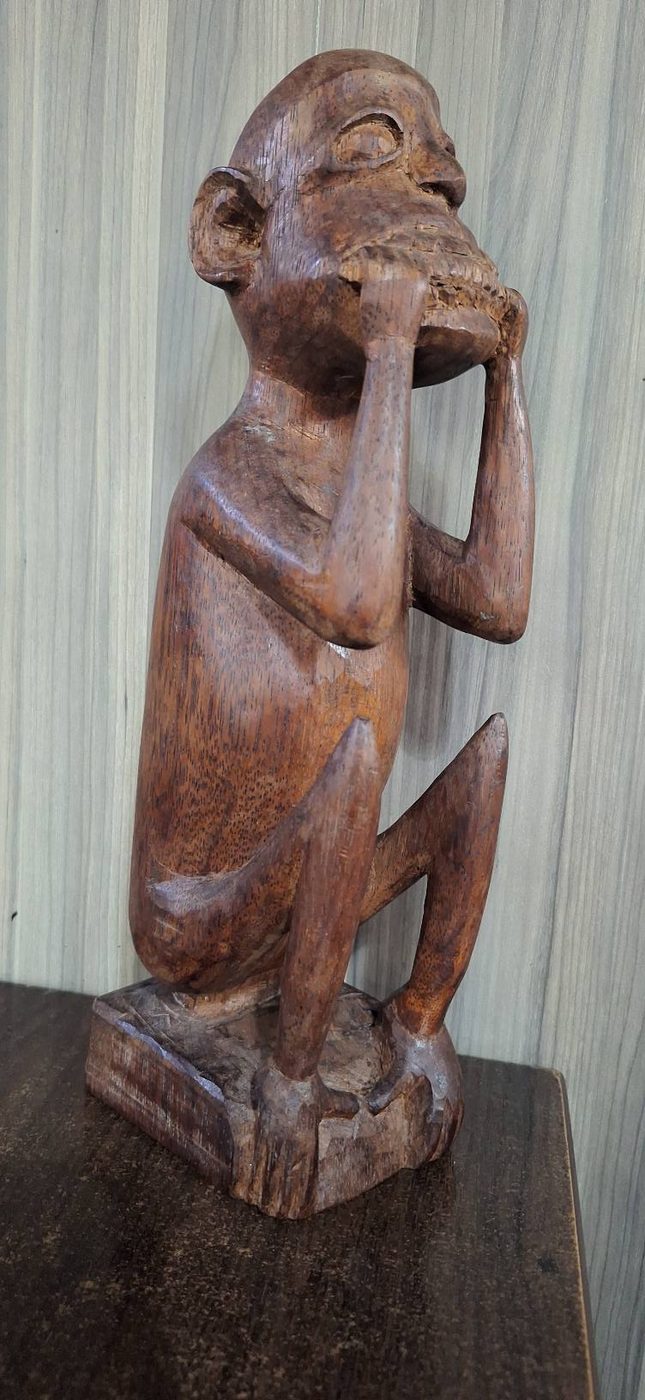
It sits in contemplation. Hands raised to its face — not in distress, but in the posture of one who listens inward. The wood is dense, warm, carrying in its grain the memory of the forest from which it was cut. Three angles, one presence: a being that is simultaneously primate, ancestor, and philosophical proposition.
This is Moyang Siamang — carved by a Jah Hut or Mah Meri master carver of Peninsular Malaysia, and one of more than 460 documented moyang spirit forms in the animist cosmological atlas of the Orang Asli, the original peoples of this ancient land.
Before dawn in the forests of Pahang, the siamang gibbon calls. That vast, reverberating cry — unlike any other sound in the canopy — fills the mist-laden air with something that sounds less like animal communication and more like ritual invocation. The Orang Asli have known this for millennia. They did not need science to tell them that this creature stands close to the threshold between the human and the more-than-human world. They carved the knowledge instead — into hardwood, into ceremony, into the hands of healers.
Malaysia holds three living cosmological traditions that each look upon this figure and see something different — yet each, in their own grammar, recognises in it a truth about the boundary between worlds.
The Forest Remembers: An Orang Asli Reading
Look at the posture of the figure: seated, grounded, both hands raised to the face in an attitude of concentrated inwardness — not withdrawal, but deep attention. In the animist cosmology of the Orang Asli, this is precisely the gesture of the halak or poyang, the shaman, in the moment of spirit communication. The hands at the face mark the threshold between ordinary perception and the seeing that reaches beyond it.
The Orang Asli are the aboriginal peoples of Peninsular Malaysia — eighteen distinct sub-groups divided into three broad language families, the Negrito (Semang), the Senoi, and the Proto-Malay — together one of the most ancient human presences in the region, their roots running back well before 1000 BCE. Among them, the Jah Hut and the Mah Meri are the most celebrated carvers, producing figures of a spiritual precision that Western art history took far too long to recognise as the sophisticated cosmological objects they are.
The moyang are not gods in any Western theological sense. They are ancestor spirits — beings who have crossed from the living world into the unseen one, and who retain both the knowledge of their former lives and the power of their new position at the boundary between realms. Moyang Siamang is associated with the siamang gibbon (Symphalangus syndactylus), the largest of the lesser apes and one of the most acoustically extraordinary animals in the rainforest: its call, a duet between bonded pairs amplified by an inflatable throat sac, carries for kilometres through the canopy. For the shaman that call is not merely animal sound. It is a signal from the spirit world — a summons, a diagnostic message about the state of the invisible domain that shadows and governs the visible one.
In healing ceremonies the halak enters trance, facilitated by the communal Sewang ritual of song and percussion, and calls upon specific moyang for assistance. Moyang Siamang may be invoked in illness believed to originate in a disrupted relationship with the forest — a taboo violated, a spirit disrespected, a boundary between human and animal worlds transgressed carelessly. The carved figure is the moyang’s body in the human world: not a representation of the spirit but a material address where it can be spoken to, fed with offerings, and from which it can be called to act.
The Mah Meri carve from nyireh batu, a hardwood of the coastal mangrove forests of Carey Island, and fewer than twenty-five master carvers still practise the tradition, each working from a catalogue of over a hundred distinct spirit forms passed down through apprenticeship and oral instruction. When the last carver of a particular form puts down his adze, that moyang loses its material address in the human world. The spirit is not lost — the Orang Asli would say it does not die — but the conversation between the living and the ancestral becomes harder to sustain. The forest that produced both the siamang and the carver is the same forest. When one goes, the other follows.
One Word, Many Persons: The Logic of Orang
In Malay, orang means “person.” Paired with a modifier it creates identity categories based on origin, habitat, or foreignness — and the same small word bridges humans, animals, and foreigners through a single cultural logic. Orang Asli, “original people,” are the indigenous groups of the peninsula. Orang-utan, “person of the forest” (from hutan), first meant forest-dwelling humans and was later extended to the great ape whose intelligence and form seemed so nearly human. Orang Belanda, “Dutch person,” names the foreigner from across the sea — and, in a characteristic twist, is also the Malay name for the long-nosed proboscis monkey of Borneo.
| Aspect | Orang Asli | Orang-utan | Orang Belanda |
|---|---|---|---|
| Modifier | Origin (asli) | Habitat (utan) | Origin (Belanda) |
| Refers to | Indigenous humans | Non-human ape | Foreign humans |
| Cultural view | Native, ancestral | Wise, semi-human | Foreign, colonial |
The pattern is always the same: orang + modifier → identity by origin, habitat, or foreignness. The language blurs the human–animal boundary precisely where anthropomorphic traits are recognised; the orangutan is literally a “forest person,” named for its closeness to us. To carve Moyang Siamang is to work inside exactly this worldview — one in which the living world has always included more kinds of persons than the anthropocentric imagination admits.
The Chinese Lens: Sun Wukong, the Monkey King
To the Chinese communities of Malaysia, the sacred primate wears another face: Sun Wukong, the Monkey King of the sixteenth-century novel Journey to the West. Born from stone, master of seventy-two transformations, he storms the halls of heaven before being subdued and set on a pilgrimage that turns rebellion into discipline and, at last, into buddhahood. Where the moyang is an ancestor to be addressed, Sun Wukong is a trickster to be honoured: worshipped in temples as the Great Sage Equal to Heaven, a guardian who defeats demons precisely because he was once the most unruly of them. The monkey here is not a threshold-keeper of the forest but a threshold-crosser of the cosmos — the disorderly power that, once tamed, protects.
The Indian Lens: Hanuman, the Devoted
To Malaysia’s Tamil Hindu communities, the monkey is Hanuman — the vanara hero of the Ramayana, who leaps oceans, carries a mountain of healing herbs, and burns the golden city of Lanka with his tail, all in selfless service to Rama. If Sun Wukong is rebellion redeemed, Hanuman is devotion made superhuman: strength placed wholly at the service of the divine. At the Batu Caves on the edge of Kuala Lumpur, a towering gilded Hanuman and the great Murugan statue draw pilgrims by the hundreds of thousands — the monkey god fully at home in the Malaysian landscape, a few valleys from the forests where the halak still carves the siamang.
Three Worlds, One Ancestor
Ancestor spirit, tamed rebel, devoted servant: three traditions look at the primate form and read three different truths into it — and yet each recognises the same thing, that the creature which so resembles us stands close to the boundary between the human and the more-than-human, and can be made to speak across it. One carved ancestor. Three ancient traditions. One disappearing forest, whose silence would leave all three the poorer.
Stă în contemplație. Mâinile ridicate la față — nu în tulburare, ci în postura celui care ascultă înlăuntru. Lemnul este dens, cald, purtând în fibra sa amintirea pădurii din care a fost tăiat. Trei unghiuri, o singură prezență: o ființă care este deopotrivă primat, strămoș și propunere filosofică.
Acesta este Moyang Siamang — sculptat de un maestru Jah Hut sau Mah Meri din Peninsula Malaeză și una dintre cele peste 460 de forme documentate de spirit moyang din atlasul cosmologic animist al poporului Orang Asli, populația originară a acestui ținut străvechi.
Înainte de zori, în pădurile din Pahang, gibonul siamang își strigă chemarea. Acel strigăt vast, reverberant — deosebit de orice alt sunet din baldachin — umple aerul încețoșat cu ceva ce sună mai puțin a comunicare animală și mai mult a invocație rituală. Poporul Orang Asli a știut aceasta de milenii. Nu a avut nevoie de știință spre a-i spune că această creatură stă aproape de hotarul dintre lumea umană și cea mai-mult-decât-umană. A sculptat cunoașterea în schimb — în lemn tare, în ceremonie, în mâinile vindecătorilor.
Malaysia adăpostește trei tradiții cosmologice vii care privesc fiecare această figură și văd altceva — și totuși fiecare, în gramatica proprie, recunoaște în ea un adevăr despre hotarul dintre lumi.
Pădurea își amintește: o lectură Orang Asli
Priviți postura figurii: așezată, ancorată, cu ambele mâini ridicate la față într-o atitudine de concentrare interioară — nu retragere, ci atenție profundă. În cosmologia animistă a poporului Orang Asli, acesta este tocmai gestul halak-ului sau al poyang-ului, șamanul, în clipa comunicării cu spiritele. Mâinile la față marchează pragul dintre percepția obișnuită și vederea care ajunge dincolo de ea.
Poporul Orang Asli este format din popoarele aborigene ale Peninsulei Malaeze — optsprezece subgrupuri distincte, împărțite în trei mari familii lingvistice: negrito (semang), senoi și proto-malaezienii — laolaltă una dintre cele mai vechi prezențe umane din regiune, cu rădăcini ce coboară cu mult înainte de anul 1000 î.Hr. Între ei, Jah Hut și Mah Meri sunt cei mai vestiți sculptori, dând figuri de o precizie spirituală pe care istoria artei occidentale a întârziat mult să le recunoască drept obiectele cosmologice sofisticate care sunt.
Moyang nu sunt zei în vreun sens teologic occidental. Sunt spirite-strămoși — ființe care au trecut din lumea celor vii în cea nevăzută și care păstrează atât cunoașterea vieților lor de dinainte, cât și puterea noii lor poziții, la hotarul dintre tărâmuri. Moyang Siamang este asociat gibonului siamang (Symphalangus syndactylus), cea mai mare dintre maimuțele mici și una dintre cele mai extraordinare acustic vietăți ale pădurii tropicale: chemarea sa, un duet între partenerii înperecheați amplificat de un sac laringian gonflabil, se aude kilometri întregi prin baldachin. Pentru șaman, acea chemare nu este simplu sunet animal. Este un semnal din lumea spiritelor — o convocare, un mesaj diagnostic despre starea domeniului nevăzut care umbrește și guvernează lumea văzută.
În ceremoniile de vindecare, halak-ul intră în transă, înlesnit de ritualul comunal Sewang, un ciclu de cânt și percuție la care participă întreaga comunitate, și cheamă anumiți moyang în ajutor. Moyang Siamang poate fi invocat în boli despre care se crede că își au originea într-o relație tulburată cu pădurea — un tabu încălcat, un spirit necinstit, un hotar dintre lumea umană și cea animală trecut cu nepăsare. Figura sculptată este trupul moyang-ului în lumea umană: nu o reprezentare a spiritului, ci o adresă materială unde acesta poate fi vorbit, hrănit cu ofrande și de unde poate fi chemat să lucreze.
Cei din poporul Mah Meri sculptează din nyireh batu, un lemn tare din pădurile de mangrove de coastă ale Insulei Carey, iar mai puțin de douăzeci și cinci de maeștri sculptori mai practică tradiția, fiecare lucrând dintr-un catalog de peste o sută de forme distincte de spirit, transmise prin ucenicie și învățătură orală. Când ultimul sculptor al unei anume forme își pune jos teslă, acel moyang își pierde adresa materială în lumea umană. Spiritul nu se pierde — poporul Orang Asli ar spune că el nu moare — dar conversația dintre cei vii și strămoși devine mai greu de susținut. Pădurea care a dat deopotrivă gibonul și sculptorul este aceeași pădure. Când unul se duce, celălalt îl urmează.
Un singur cuvânt, mulți oameni: logica lui orang
În malaeză, orang înseamnă „persoană”. Alăturat unui modificator, creează categorii de identitate întemeiate pe origine, habitat sau apartenență străină — iar același cuvânt mic leagă oamenii, animalele și străinii printr-o singură logică culturală. Orang Asli, „oamenii dintâi”, sunt grupurile indigene ale peninsulei. Orang-utan, „persoană a pădurii” (de la hutan), a însemnat mai întâi oameni ai pădurii și a fost extins apoi la marea maimuță a cărei inteligență și formă păreau atât de aproape de om. Orang Belanda, „persoană olandeză”, îl numește pe străinul de peste mări — și, printr-o răsucire caracteristică, este totodată numele malaez al maimuței-proboscis din Borneo.
| Aspect | Orang Asli | Urangutan | Orang Belanda |
|---|---|---|---|
| Modificator | Origine (asli) | Habitat (utan) | Origine (Belanda) |
| Se referă la | Oameni indigeni | Maimuță (non-umană) | Oameni străini |
| Viziune culturală | Nativ, ancestral | Înțelept, semi-uman | Străin, colonial |
Tiparul este mereu același: orang + modificator → identitate după origine, habitat sau apartenență străină. Limba estompează hotarul dintre om și animal tocmai acolo unde sunt recunoscute trăsături antropomorfe; urangutanul este, literalmente, o „persoană a pădurii”, numit astfel pentru apropierea sa de noi. A sculpta Moyang Siamang înseamnă a lucra chiar înlăuntrul acestei viziuni — una în care lumea vie a cuprins dintotdeauna mai multe feluri de persoane decât îngăduie imaginația antropocentrică.
Lentila chineză: Sun Wukong, Regele Maimuță
Pentru comunitățile chineze din Malaysia, primatul sacru poartă un alt chip: Sun Wukong, Regele Maimuță al romanului din secolul al XVI-lea Călătorie spre Apus. Născut din piatră, stăpân a șaptezeci și două de metamorfoze, ia cu asalt sălile cerului înainte de a fi îmblânzit și trimis într-un pelerinaj care preface răzvrătirea în disciplină și, în cele din urmă, în budeitate. Acolo unde moyang este un strămoș căruia i se vorbește, Sun Wukong este un farsor cinstit în temple ca Marele Înțelept Deopotrivă cu Cerul, un gardian care învinge demonii tocmai pentru că a fost cândva cel mai neîmblânzit dintre ei. Maimuța nu este aici un păzitor al pragului pădurii, ci un traversator al pragului cosmosului — puterea dezordonată care, odată domolită, ocrotește.
Lentila indiană: Hanuman, cel devotat
Pentru comunitățile hinduse tamile din Malaysia, maimuța este Hanuman — eroul vanara din Ramayana, care sare peste oceane, cară un munte de ierburi tămăduitoare și arde cetatea de aur a Lankăi cu coada sa, totul în slujba dezinteresată a lui Rama. Dacă Sun Wukong este răzvrătirea răscumpărată, Hanuman este devotamentul înălțat la supraomenesc: forța pusă întru totul în slujba divinului. La Peșterile Batu, la marginea orașului Kuala Lumpur, un Hanuman aurit, uriaș, și marea statuie a lui Murugan atrag sute de mii de pelerini — zeul-maimuță pe deplin acasă în peisajul malaezian, la câteva văi depărtare de pădurile unde halak-ul încă sculptează gibonul.
Trei lumi, un singur strămoș
Spirit-strămoș, răzvrătit îmblânzit, slujitor devotat: trei tradiții privesc forma primatului și citesc în ea trei adevăruri diferite — și totuși fiecare recunoaște același lucru, că vietatea care ne seamănă atât de mult stă aproape de hotarul dintre uman și mai-mult-decât-uman și poate fi făcută să vorbească peste el. Un singur strămoș sculptat. Trei tradiții străvechi. O singură pădure care dispare, a cărei tăcere le-ar sărăci pe toate trei.