Curatorial note. This piece is a companion to the broader essay on the Mah Meri Moyang; here the focus narrows to a single carving. The reading follows the published record — Roland Werner’s Culture of Healing (1997) and Wazir-Jahan Karim’s Ma’ Betisek Concepts of Living Things (1981) — and marks its interpretive links to Mircea Eliade as interpretation. It is presented bilingually; use the language selector above for the Romanian edition.Notă curatorială. Această piesă este o însoțitoare a eseului mai larg despre spiritele Moyang ale poporului Mah Meri; aici privirea se îngustează asupra unei singure sculpturi. Lectura urmează consemnarea publicată — Culture of Healing (1997) de Roland Werner și Ma’ Betisek Concepts of Living Things (1981) de Wazir-Jahan Karim — și marchează legăturile ei cu Mircea Eliade drept interpretare. Este prezentat bilingv; folosiți selectorul de limbă de mai sus pentru ediția în română.
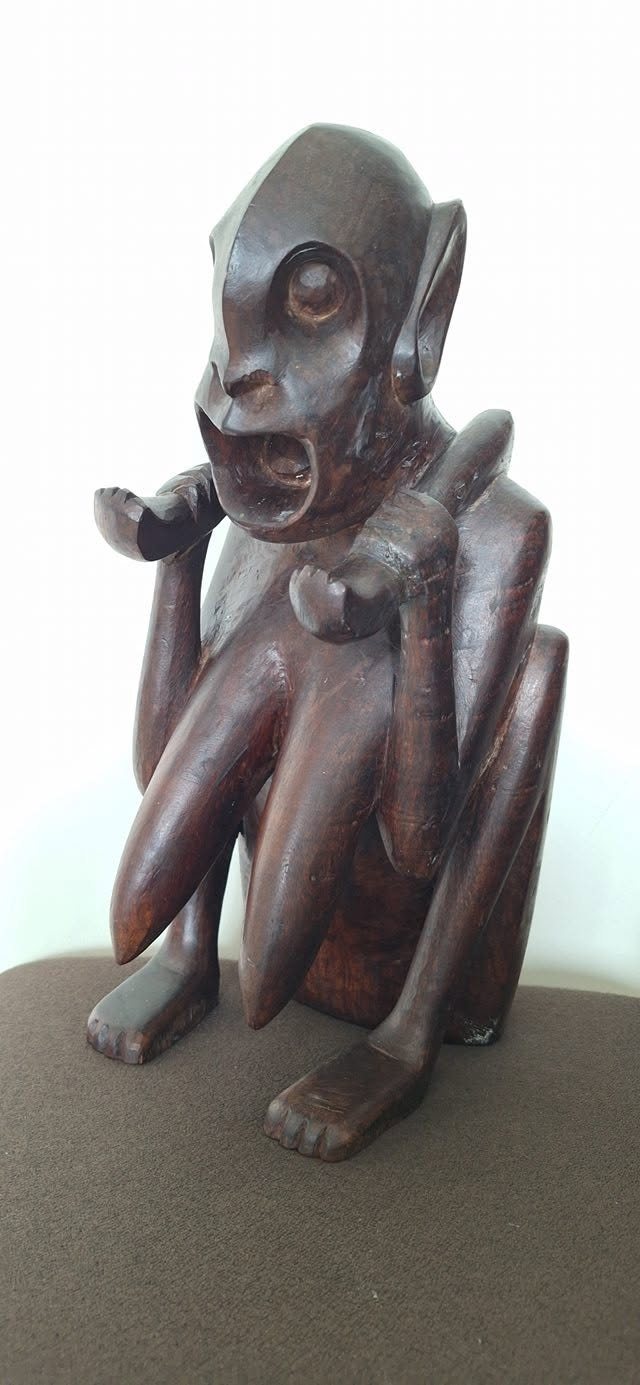
It sits low and gathers itself inward. The knees are pulled up almost to the chin; the great splayed feet are planted flat and forward; one hand rises toward the face, the other grips across the body. The head is a smooth ovoid, the ears set high and pointed, the eyes two raised discs, and the mouth is wrenched open on a row of bared teeth. Cut from a single block of dark, close-grained hardwood and worn to a deep shine, this is a Mah Meri Moyang — an ancestor-spirit given a body — and almost everything the tradition means by that word is legible in how the figure is posed.
Stă jos și se adună în sine. Genunchii sunt trași aproape până la bărbie; tălpile mari, răsfirate, sunt înfipte drept și înainte; o mână se ridică spre chip, cealaltă apucă de-a curmezișul trupului. Capul este un ovoid neted, urechile așezate sus și ascuțite, ochii două discuri în relief, iar gura este smulsă în lături peste un șir de dinți dezgoliți. Tăiat dintr-un singur bloc de lemn tare, întunecat și cu fibra deasă, și lustruit până la o strălucire adâncă, acesta este un Moyang Mah Meri — un spirit-strămoș căruia i s-a dat un trup — și aproape tot ce înțelege tradiția prin acest cuvânt se poate citi în felul în care este așezată figura.
I. The body drawn inI. Trupul adunat în sine
The dominant fact of the carving is its crouch. Art historians call this the Hocker — the deep squat, knees to chest, that recurs in ancestral imagery across the archipelago and far beyond it. It is not a naturalistic pose but a formula, and its meaning is compression: the body folded back into the smallest, densest version of itself, all limbs gathered toward a centre. The oversized feet, carved flat and frontal, root the figure to the ground even as the torso coils; it is at once utterly still and utterly tensed, a spring held down. The Mah Meri carver has not depicted a person resting. He has depicted potential held under pressure.
Faptul dominant al sculpturii este ghemuirea ei. Istoricii artei o numesc Hocker — ghemuirea adâncă, cu genunchii la piept, care revine în imagistica ancestrală din tot arhipelagul și cu mult dincolo de el. Nu este o poză naturalistă, ci o formulă, iar sensul ei este comprimarea: trupul reîntors în versiunea sa cea mai mică și mai densă, toate membrele adunate spre un centru. Tălpile supradimensionate, cioplite plat și frontal, înrădăcinează figura în pământ chiar în timp ce trunchiul se încolăcește; este deodată cu totul nemișcată și cu totul încordată, un resort ținut apăsat. Sculptorul Mah Meri nu a înfățișat un om odihnindu-se. A înfățișat un potențial ținut sub presiune.
II. The fanged mouthII. Gura colțată
Above the coiled body the face breaks open. The mouth is levered wide on bared teeth, the eyes bulge, the ears prick — an expression that is neither serene nor human, but alert, fierce, on guard. Many Moyang are protectors, and a bared, fanged mouth belongs to the ancestor as boundary-keeper: the spirit stationed at the edge between the ordered human world and the wild forces of forest, tide and sickness, whose task is to face outward and repel what should not cross. The open mouth may also be a voice — the ancestor caught mid-cry, mid-song, in the act of being addressed and answering. Either way the face is a threshold: the point where the spirit meets the living and makes its power felt.
Deasupra trupului încolăcit, chipul se deschide brusc. Gura este pârghiată larg peste dinți dezgoliți, ochii se bulbucă, urechile se ciulesc — o expresie care nu este nici senină, nici omenească, ci atentă, aprigă, de strajă. Multe Moyang sunt ocrotitori, iar o gură dezgolită, colțată, aparține strămoșului ca păzitor al hotarului: spiritul postat la marginea dintre lumea omenească rânduită și forțele sălbatice ale pădurii, ale mareei și ale bolii, a cărui menire este să privească în afară și să respingă ceea ce nu trebuie să treacă. Gura deschisă poate fi și un glas — strămoșul prins în plin strigăt, în plin cânt, în actul de a i se vorbi și de a răspunde. Oricum ar fi, chipul este un prag: punctul unde spiritul întâlnește pe cei vii și își face simțită puterea.
III. The wood as ladderIII. Lemnul ca scară
The Mah Meri carve in nyireh batu, a dense mangrove hardwood, and the choice is not only technical. The mangrove is the tree of the tidal boundary — rooted where land meets sea, fresh meets salt, the living meet the drowned — the very threshold this ancestor guards. Read through Eliade, such a material is more than a medium; it is an axis mundi, a growing ladder joining the human world to the spirit world, so that the substance of the carving already carries its meaning. The dark polish of the surface is the mark of decades of ritual handling: the wood has been touched, fed and honoured until it holds the sheen of a thing kept alive.
Mah Meri cioplesc în nyireh batu, un lemn tare și dens de mangrovă, iar alegerea nu este doar tehnică. Mangrova este copacul hotarului mareelor — înrădăcinat acolo unde uscatul întâlnește marea, apa dulce întâlnește sarea, cei vii îi întâlnesc pe cei înecați — chiar pragul pe care îl păzește acest strămoș. Citit prin Eliade, un asemenea material este mai mult decât un mediu; este un axis mundi, o scară vie care unește lumea omenească de lumea spiritelor, astfel încât substanța sculpturii îi poartă deja înțelesul. Lustrul întunecat al suprafeței este semnul a decenii de manevrare rituală: lemnul a fost atins, hrănit și cinstit până când a prins luciul unui lucru ținut viu.
IV. The ancestor about to returnIV. Strămoșul pe cale să se întoarcă
Return, finally, to the crouch. Scholars have long linked the Hocker to the fetal position — the body folded into the shape of the not-yet-born — and it is here that Eliade’s framework fits most closely. In his account of the archaic religious imagination, the fetal posture is the posture of eternal potential: the being poised at the still point between death and a rebirth that ritual can bring about. The ancestor crouches because the ancestor is never finally gone; it waits, coiled, to be summoned back into presence at the festival, in the dance, under the carver’s renewing hand. And in the pared ovoid of the head, reduced almost to a pure egg, one meets the same instinct the collection follows in Brâncuși: the search for the essential form in which a life is held before, and after, it takes its particular shape.
Să ne întoarcem, în sfârșit, la ghemuire. Cercetătorii au legat de mult Hocker-ul de poziția fetală — trupul împăturit în forma celui încă nenăscut — și tocmai aici se potrivește cel mai strâns cadrul lui Eliade. În descrierea lui a imaginației religioase arhaice, poziția fetală este poziția potențialului etern: ființa aflată în cumpănă, în punctul neclintit dintre moarte și o renaștere pe care ritualul o poate înfăptui. Strămoșul stă ghemuit fiindcă strămoșul nu este niciodată plecat cu totul; așteaptă, încolăcit, să fie chemat înapoi în prezență la sărbătoare, în dans, sub mâna înnoitoare a sculptorului. Iar în ovoidul redus al capului, adus aproape la un ou pur, întâlnești același instinct pe care colecția îl urmează la Brâncuși: căutarea formei esențiale în care o viață este ținută înainte de a-și lua — și după ce și-a luat — înfățișarea anume.
ConclusionConcluzie
Crouched, fanged, planted and coiled, this single Moyang holds the whole argument of the Mah Meri carvings in one body: the ancestor as guardian of a threshold, the wood as the ladder across it, the fetal crouch as the promise of return. It is not a statue of a spirit. It is a spirit given a place to wait among the living — and, in the fierce patience of its pose, a reminder that among the Mah Meri the dead are never merely mourned. They are kept, fed, and expected back.
Ghemuit, colțat, înfipt și încolăcit, acest singur Moyang ține întregul argument al sculpturilor Mah Meri într-un singur trup: strămoșul ca păzitor al unui prag, lemnul ca scară peste el, ghemuirea fetală ca făgăduință a întoarcerii. Nu este statuia unui spirit. Este un spirit căruia i s-a dat un loc unde să aștepte printre cei vii — și, în răbdarea aprigă a poziției sale, o amintire că, la Mah Meri, morții nu sunt niciodată doar jeliți. Sunt păstrați, hrăniți și așteptați să se întoarcă.
Notes & sourcesNote și surse
- Companion essay. For the female Moyang Sakat, the soul-carrying Moyang Gabos and the Jo-oh dance, see The Carriers of the Soul: Reading the Mah Meri Moyang.Eseu însoțitor. Pentru Moyang Sakat cea feminină, Moyang Gabos care poartă sufletul și dansul Jo-oh, vezi Purtătorii sufletului: o lectură a spiritelor Moyang ale poporului Mah Meri.
- Documentation. Roland Werner, Mah-Meri: Culture of Healing in Malaysia (University of Malaya Press, 1997), catalogues the individual Moyang, their traits and the crouched (“Hocker”) posture; Wazir-Jahan Begum Karim, Ma’ Betisek Concepts of Living Things (Athlone Press, 1981), reads them as active agents in the community’s health.Documentare. Roland Werner, Mah-Meri: Culture of Healing in Malaysia (University of Malaya Press, 1997), inventariază Moyang individuale, trăsăturile lor și poziția ghemuită („Hocker”); Wazir-Jahan Begum Karim, Ma’ Betisek Concepts of Living Things (Athlone Press, 1981), le citește ca agenți activi în sănătatea comunității.
- Eliade. The fetal/“Hocker” posture as eternal potential, and the tree as axis mundi, follow M. Eliade, The Sacred and the Profane (1957) and The Myth of the Eternal Return (1949); the identification of this figure’s specific Moyang name is left open, and the Eliadean readings are interpretive.Eliade. Poziția fetală/„Hocker” drept potențial etern și copacul drept axis mundi urmează M. Eliade, Sacrul și profanul (1957) și Mitul eternei reîntoarceri (1949); identificarea numelui Moyang anume al acestei figuri rămâne deschisă, iar lecturile eliadiene sunt interpretative.
- Provenance. Held in the PacificaRomania collection; first exhibited at the Embassy of Romania in Canberra (2019–2020).Proveniență. Se află în colecția PacificaRomania; expus pentru prima dată la Ambasada României la Canberra (2019–2020).