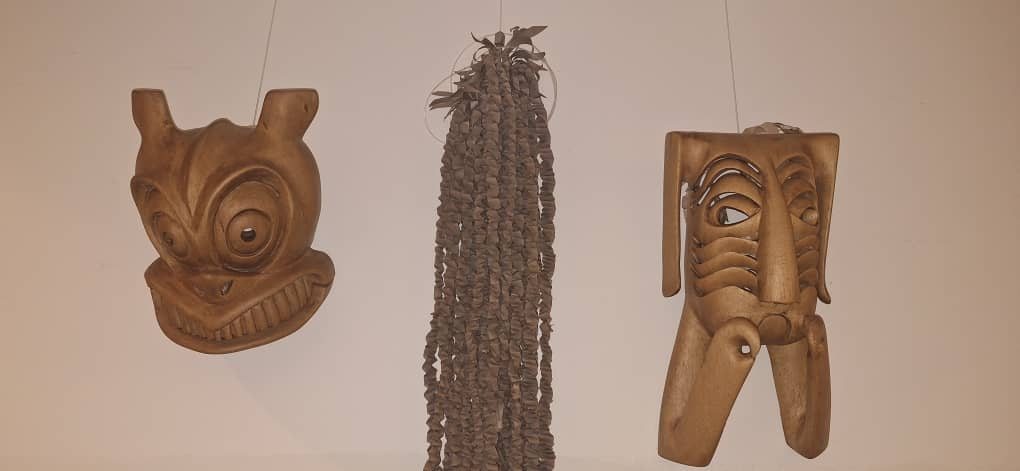
Curatorial note. This essay reads the Moyang carvings of the Mah Meri (Ma’ Betisek) of Pulau Carey, Selangor, against the scholarship that has documented them — above all Roland Werner’s Mah-Meri: Culture of Healing in Malaysia (1997) and Wazir-Jahan Karim’s Ma’ Betisek Concepts of Living Things (1981) — and against Mircea Eliade’s history of religions. Where the tradition’s detail is contested or restricted, the essay follows the published record and marks interpretation as interpretation. It is presented bilingually; use the language selector above for the Romanian edition.Notă curatorială. Acest eseu citește sculpturile Moyang ale poporului Mah Meri (Ma’ Betisek) din Pulau Carey, Selangor, în raport cu studiile care le-au documentat — mai ales Mah-Meri: Culture of Healing in Malaysia (1997) de Roland Werner și Ma’ Betisek Concepts of Living Things (1981) de Wazir-Jahan Karim — și cu istoria religiilor a lui Mircea Eliade. Acolo unde amănuntul tradiției este disputat sau restricționat, eseul urmează consemnarea publicată și marchează interpretarea ca interpretare. Este prezentat bilingv; folosiți selectorul de limbă de mai sus pentru ediția în română.
The Mah Meri of Pulau Carey, one of the Orang Asli peoples of coastal Selangor, carve some of the most refined sculpture in Southeast Asia: masks and standing figures cut from mangrove hardwood and named for the spirits they hold. The word for these spirits — and, by extension, for the carvings that house them — is Moyang: ancestor, forebear, the founding presence of a place or a power. To the outside eye they are art; to the Mah Meri they are agents, with names, appetites, jurisdictions and the power to sicken or to heal.
Poporul Mah Meri din Pulau Carey, unul dintre popoarele Orang Asli de pe coasta statului Selangor, cioplește unele dintre cele mai rafinate sculpturi din Asia de Sud-Est: măști și figuri în picioare tăiate din lemnul tare de mangrovă și numite după spiritele pe care le adăpostesc. Cuvântul pentru aceste spirite — și, prin extensie, pentru sculpturile care le găzduiesc — este Moyang: strămoș, înaintaș, prezența întemeietoare a unui loc sau a unei puteri. Ochiului din afară îi par artă; pentru Mah Meri sunt agenți, cu nume, pofte, jurisdicții și puterea de a îmbolnăvi sau de a tămădui.
I. Spirits, not statuesI. Spirite, nu statui
Roland Werner’s Culture of Healing catalogues hundreds of distinct Moyang, each with its own visual signature and ritual use, and it is the record against which any single figure can be identified. But the deeper point is made by Wazir-Jahan Karim, whose Ma’ Betisek Concepts of Living Things shows that these spirits are not decorative survivals but working parts of a cosmology: the Moyang govern the relationship between the community and its living environment, and the carver’s work is a form of maintenance, keeping the ancestors present so that the world stays in balance. To carve a Moyang is less to represent a spirit than to give it a place to sit among the living.
Cartea lui Roland Werner, Culture of Healing, inventariază sute de Moyang distincte, fiecare cu semnătura sa vizuală și cu întrebuințarea sa rituală, și este consemnarea în raport cu care poate fi identificată orice figură în parte. Dar miezul mai adânc este rostit de Wazir-Jahan Karim, a cărei carte Ma’ Betisek Concepts of Living Things arată că aceste spirite nu sunt supraviețuiri decorative, ci piese lucrătoare ale unei cosmologii: Moyang cârmuiesc relația dintre comunitate și mediul ei viu, iar munca sculptorului este o formă de întreținere, ținând strămoșii prezenți spre ca lumea să rămână în echilibru. A ciopli un Moyang înseamnă mai puțin a reprezenta un spirit, cât a-i da un loc unde să șadă printre cei vii.
II. Moyang Sakat and the female powersII. Moyang Sakat și puterile feminine
Among the most charged figures in the documented corpus are the female Moyang, of whom Moyang Sakat is the type. They are carved with long, pendulous breasts and, often, a seated or crouched posture, and their domain is the one the outside world has most often failed to see as sacred: fertility, nurture, the hearth, the health of women, and the taboos that guard all of these. Read through Eliade, such a figure is a hierophany of the maternal — the sacred disclosed not as thunder or height but as the body that feeds, the power on which continuity itself depends. To carve her is to keep the source of life under the eye of the ancestors.
Printre cele mai încărcate figuri din corpusul documentat se numără Moyang feminine, dintre care Moyang Sakat este tipul. Sunt cioplite cu sâni lungi, atârnând, și, adesea, într-o poziție șezândă sau ghemuită, iar domeniul lor este tocmai cel pe care lumea din afară a izbutit cel mai rar să-l vadă drept sacru: fertilitatea, hrănirea, vatra, sănătatea femeilor și tabuurile care le păzesc pe toate acestea. Citită prin Eliade, o asemenea figură este o hierofanie a maternului — sacrul dezvăluit nu ca tunet sau înălțime, ci ca trupul care hrănește, puterea de care depinde însăși continuitatea. A o ciopli înseamnă a ține izvorul vieții sub ochiul strămoșilor.
III. Moyang Gabos: the carrier of the soulIII. Moyang Gabos: purtătorul sufletului
The most philosophically striking of the Moyang is the carrier — recorded in the tradition as Moyang Gabos (also linked with the name Bajus) and identified by the double-figure motif: one figure bearing another upon its back or shoulders. The reading preserved in the scholarship is that of the psychopomp: the ancestor who takes up the weight of the living soul and carries it across the threshold, protector and ferryman at once. It is a compact image of what an ancestor is — not a memory of the dead but a bearer of the living, the one who shoulders those who cannot yet cross alone.
Cea mai izbitoare filosofic dintre Moyang este purtătorul — consemnat în tradiție drept Moyang Gabos (legat și de numele Bajus) și recunoscut după motivul figurii duble: o figură care poartă o alta pe spate sau pe umeri. Lectura păstrată în studii este cea a psihopompului: strămoșul care ia asupra sa greutatea sufletului viu și îl trece peste prag, deopotrivă ocrotitor și luntraș. Este o imagine concentrată a ceea ce este un strămoș — nu o amintire a morților, ci un purtător al celor vii, cel care îi ia pe umeri pe cei ce nu pot încă trece singuri.
IV. The crouch and the wood: Eliade’s two laddersIV. Ghemuirea și lemnul: cele două scări ale lui Eliade
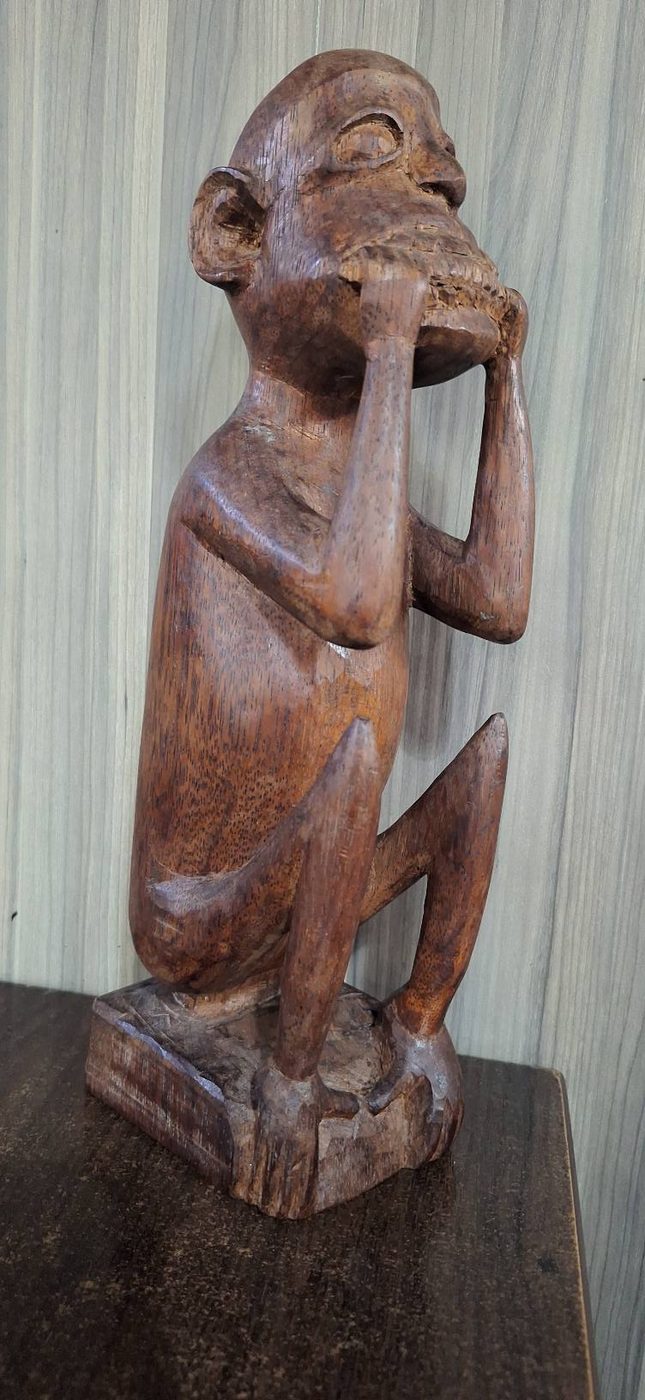
Two features of the carvings invite Eliade’s framework directly. The first is the crouched, knees-drawn-up posture that art historians call the Hocker — a pose found in ancestral imagery across the archipelago and beyond. Scholars have linked it to the primordial fetal position, the body folded back into the shape of the not-yet-born; in Eliade’s terms it is the posture of eternal potential, of the being poised between death and a rebirth that ritual can bring about. The ancestor crouches because the ancestor is always about to return.
Două trăsături ale sculpturilor cheamă direct cadrul lui Eliade. Prima este poziția ghemuită, cu genunchii strânși la piept, pe care istoricii artei o numesc Hocker — o poză întâlnită în imagistica ancestrală din tot arhipelagul și dincolo de el. Cercetătorii au legat-o de poziția fetală primordială, trupul reîntors în forma celui încă nenăscut; în termenii lui Eliade este poziția potențialului etern, a ființei aflate în cumpănă între moarte și o renaștere pe care ritualul o poate înfăptui. Strămoșul stă ghemuit fiindcă strămoșul este mereu pe cale să se întoarcă.
The second is the material itself. The Mah Meri carve in nyireh batu, a dense mangrove hardwood — a tree rooted in the tidal boundary between land and sea, salt and fresh, the living and the drowned. Read through Eliade, the wood is more than a medium; it is an axis mundi, a growing ladder joining the human world to the spirit world, so that the material of the carving already carries the meaning of the carving. The Moyang is a spirit given a body of the very substance that connects the worlds it moves between.
A doua este chiar materialul. Mah Meri cioplesc în nyireh batu, un lemn tare și dens de mangrovă — un copac înrădăcinat în hotarul mareelor dintre uscat și mare, sare și apă dulce, cei vii și cei înecați. Citit prin Eliade, lemnul este mai mult decât un mediu; este un axis mundi, o scară vie care unește lumea omenească de lumea spiritelor, astfel încât materialul sculpturii poartă deja înțelesul sculpturii. Moyang este un spirit căruia i s-a dat un trup din însăși substanța care leagă lumile între care se mișcă.
V. Jo-oh: the spirits dancedV. Jo-oh: spiritele dansate
The carving is only one phase of a living cycle. At the annual Hari Moyang — the ancestors’ festival — the Mah Meri perform the Jo-oh, a dance in which masked performers give the Moyang movement, voice and presence. The mask on the wall and the dancer in the clearing are the same spirit in two states: one still, one in motion. To see the Jo-oh is to understand that a Mah Meri carving is never finished in the way a Western sculpture is finished; it is a vessel that waits to be reactivated, and the festival is the moment when the ancestors are, once again, unmistakably present.
Sculptura este doar o fază a unui ciclu viu. La Hari Moyang anual — sărbătoarea strămoșilor — Mah Meri dansează Jo-oh, un dans în care interpreți mascați dau Moyang mișcare, glas și prezență. Masca de pe perete și dansatorul din poiană sunt același spirit în două stări: una nemișcată, una în mișcare. A vedea Jo-oh înseamnă a înțelege că o sculptură Mah Meri nu este niciodată terminată așa cum este terminată o sculptură occidentală; este un vas care așteaptă să fie reactivat, iar sărbătoarea este clipa în care strămoșii sunt, din nou, neîndoielnic prezenți.
Conclusion: the ancestor who carriesConcluzie: strămoșul care poartă
Female source and soul-carrier, crouched potential and mangrove ladder, still mask and dancing body: the Moyang refuse the single category the museum would like to file them under. They are at once art, medicine, law and cosmology — the sacred given a face in wood. Read through Eliade they are hierophanies; read through the Mah Meri they are kin. And the figure that says it most economically is the carrier, the ancestor bent under the weight of a living soul: the truest image, perhaps, of what any tradition of the ancestors is finally for.
Izvor feminin și purtător de suflet, potențial ghemuit și scară de mangrovă, mască nemișcată și trup dansând: Moyang refuză categoria unică sub care le-ar așeza muzeul. Sunt deodată artă, leac, lege și cosmologie — sacrul căruia i s-a dat un chip în lemn. Citite prin Eliade sunt hierofanii; citite prin Mah Meri sunt rude. Iar figura care o spune cel mai concentrat este purtătorul, strămoșul încovoiat sub greutatea unui suflet viu: cea mai adevărată imagine, poate, a ceea ce slujește, la urmă, orice tradiție a strămoșilor.
Notes & sourcesNote și surse
- The definitive catalogue. Roland Werner, Mah-Meri: Culture of Healing in Malaysia (University of Malaya Press, 1997), documents hundreds of individual Moyang, their visual traits and ritual uses, including the female spirits and the crouched (“Hocker”) posture.Catalogul definitiv. Roland Werner, Mah-Meri: Culture of Healing in Malaysia (University of Malaya Press, 1997), documentează sute de Moyang individuale, trăsăturile lor vizuale și întrebuințările rituale, inclusiv spiritele feminine și poziția ghemuită („Hocker”).
- The Moyang as active agents. Wazir-Jahan Begum Karim, Ma’ Betisek Concepts of Living Things (London: Athlone Press, 1981), reads the spirits as agents in the community’s environmental and spiritual health, not as inert “art.”Moyang ca agenți activi. Wazir-Jahan Begum Karim, Ma’ Betisek Concepts of Living Things (Londra: Athlone Press, 1981), citește spiritele ca agenți în sănătatea ecologică și spirituală a comunității, nu ca „artă” inertă.
- Recent scholarship. M. H. Zuhairi, M. R. Rosnon & J. Shaari, “A Systematic Review of the Mah Meri People in Malaysia” (2020), surveys the major research themes; F. Abd Razak et al., “Symbolic Interpretations of Mah Meri Visual Art,” Information Management and Business Review (2024), decodes the carvings semiotically. Large collections are held by the Museum of Asian Art, Universiti Malaya.Studii recente. M. H. Zuhairi, M. R. Rosnon și J. Shaari, „A Systematic Review of the Mah Meri People in Malaysia” (2020), trece în revistă temele majore de cercetare; F. Abd Razak et al., „Symbolic Interpretations of Mah Meri Visual Art”, Information Management and Business Review (2024), decodează sculpturile semiotic. Colecții mari se află la Museum of Asian Art, Universiti Malaya.
- Eliade. The fetal/“Hocker” posture as eternal potential, and the tree as axis mundi and ladder between worlds, follow M. Eliade, The Sacred and the Profane (1957) and The Myth of the Eternal Return (1949); the pairings offered here are interpretive.Eliade. Poziția fetală/„Hocker” drept potențial etern și copacul drept axis mundi și scară între lumi urmează M. Eliade, Sacrul și profanul (1957) și Mitul eternei reîntoarceri (1949); asocierile propuse aici sunt interpretative.
- The spirits danced. The Jo-oh dance and the Hari Moyang ancestors’ festival, in which the masked Moyang are brought to life, can be seen in this film.Spiritele dansate. Dansul Jo-oh și sărbătoarea strămoșilor Hari Moyang, în care Moyang mascate prind viață, pot fi văzute în acest film.
- Provenance. Held in the PacificaRomania collection; first exhibited at the Embassy of Romania in Canberra (2019–2020).Proveniență. Se află în colecția PacificaRomania; expus pentru prima dată la Ambasada României la Canberra (2019–2020).